This year, the largest range of high temperature weather hit, and the local maximum temperature can exceed 40℃, so it is necessary to prevent heatstroke and cool down.
Expert: Fu Jiaolan, chief forecaster of the Central Meteorological Observatory and senior engineer under research.
Interviewer: China Meteorological News reporter Minglu Zhang Xinhuanet reporter Yu Ziru.
Since July 6, high temperature weather above 35℃ has occurred in Xinjiang, the eastern part of northwest China, the eastern part of southwest China, North China, Huanghuai and Zhejiang. How long will this hot weather last? What is the reason? What impact will it have on production and life? Fu Jiaolan, chief forecaster of the Central Meteorological Observatory and senior engineer at the research level, interpreted it.
This hot weather has a wide range, strong intensity and long duration.
On July 7th, high temperatures of 35~38℃ occurred in central and western Inner Mongolia, eastern Gansu, central and southern Shaanxi, central and southern Shanxi, central and southern Hebei, Beijing, Tianjin, central and western Henan, western Hubei, southern Jiangsu, Shanghai, Zhejiang, eastern Sichuan and Chongqing, and reached 39℃ in Wuhai and Alashan in Inner Mongolia, Yinchuan in Ningxia, Guanzhong in Shaanxi, Yuncheng in Shanxi, Yibin in Sichuan and Southwest Chongqing. Affected by the subtropical high extending westward and northward, the influence range of high temperature weather will be further expanded in the future, and persistent high temperature weather will appear in most parts of the south.
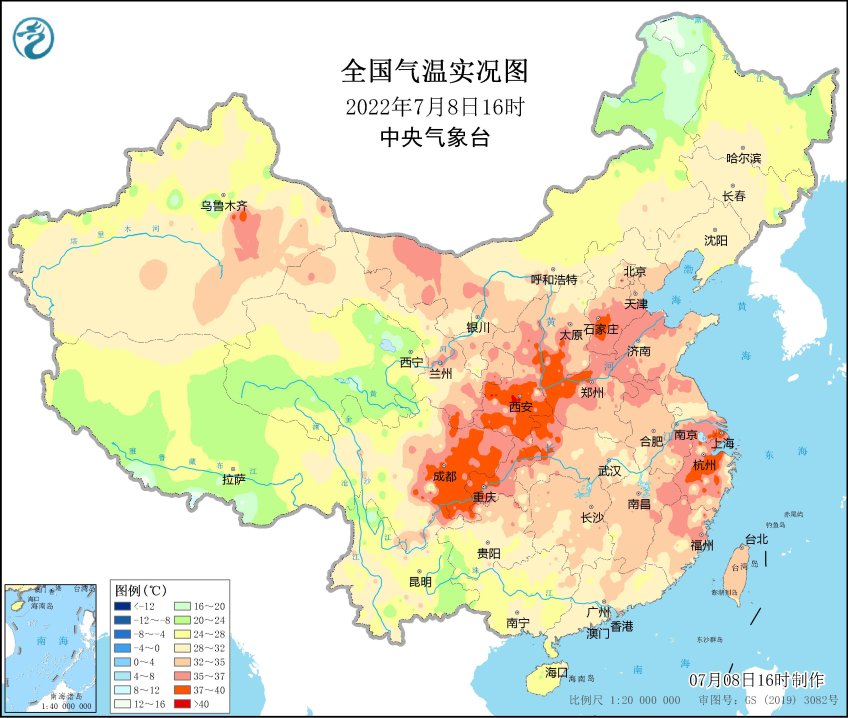
At 16: 00 on July 8, the national temperature map. Source: Central Meteorological Observatory
The Central Meteorological Observatory predicts that there will still be high temperature weather in parts of Xinjiang, western Inner Mongolia and the eastern part of northwest China from August 8 to 10. In the next 10 days, there will be persistent high temperature weather in the eastern part of Southwest China and the middle and lower reaches of the Yangtze River. The highest temperature in some areas above can reach 37~39℃, and the local highest temperature in Guanzhong Plain, Shaanxi, Zhejiang, Chongqing and Guizhou can exceed 40℃.
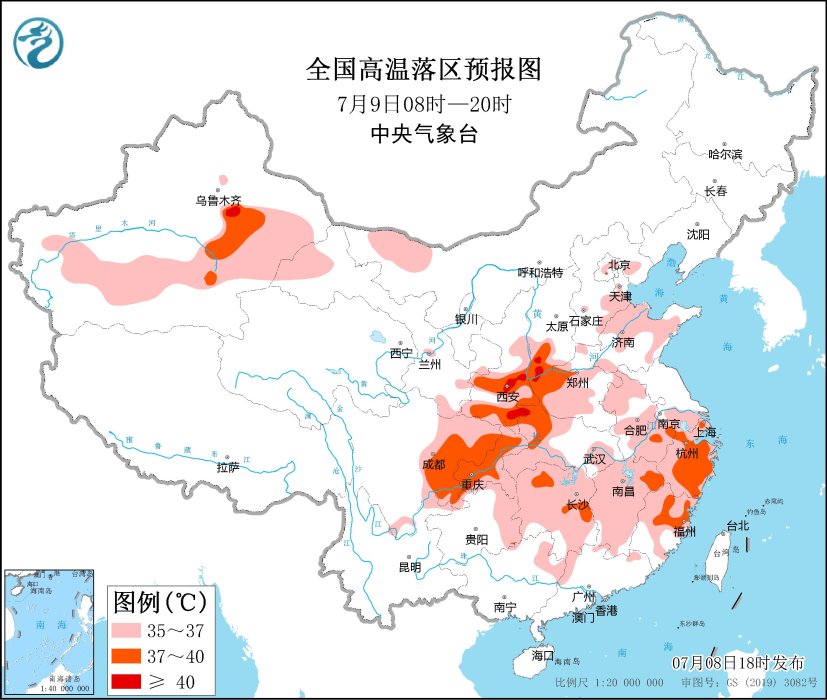
Fu Jiaolan said that this high-temperature weather process is the most widely affected high-temperature weather this year, with the characteristics of wide influence range, strong intensity and long duration. The daily maximum temperature in some areas such as the eastern part of the northwest and the eastern part of the southwest will be close to or exceed the historical extreme value in the same period, and the high-temperature weather in some areas will last for 10 days or more.
Hot weather is a normal phenomenon, but it is extreme.
Statistics from the Central Meteorological Observatory show that since June this year, there have been two large-scale high-temperature weather processes in China. The last time was from June 13th to 26th, the first regional high temperature weather process occurred in central and southern North China, Huanghuai, Jianghuai and Jianghan, covering a land area of 3.636 million square kilometers. The high temperature weather process starting from July 6 will have a wider impact and a longer duration.
Fu Jiaolan believes that it is normal for large-scale high-temperature weather to occur in summer, but the high-temperature weather that has occurred this year has certain extremes in intensity and duration. For example, temperatures in Sichuan and Gansu have successively exceeded historical extremes. From July 4th to 7th, the average daily temperature in Sichuan Province ranked first in the history of the same period, which was 2.8~6.8℃ higher than the historical period, and the highest temperature in Sichuan Basin was 5.6~11.9℃ higher than the historical period. On July 6th, high temperature weather above 37℃ occurred in Zhangye City, Gansu Province, and the highest temperature in some areas exceeded 40℃, which broke through the local historical extreme of 39.8℃.
Fu Jiaolan pointed out that high temperature weather is closely related to continental high and subtropical high. In mid-June, the warm ridge on the mainland was unusually strong, mainly controlling North China, Huanghuai and other places in China, where persistent high temperature weather appeared. At the beginning of July, Iran’s high pressure developed abnormally and moved eastward, affecting northwest and southwest China. At the same time, the subtropical high extends westward, controlling most of southern China. Affected by the ridge of high pressure, downward flow prevails in the eastern part of northwest China, the eastern part of southwest China, and the middle and lower reaches of the Yangtze River. The weather is mainly sunny and hot with little rain, and the temperature rises obviously due to the influence of solar radiation during the day.
It is necessary to guard against the influence of high temperature on power and agriculture and do a good job in heatstroke prevention and cooling.
Because of the high temperature intensity and long duration, it has adverse effects on power supply, production and domestic water, vehicle travel and agricultural production.
Fu Jiaolan suggested that all relevant departments should pay attention to weather forecast and early warning information, do a good job in power supply and water resources scheduling, and prevent fires in cities and forest areas. Especially in the middle and lower reaches of the Yangtze River, the high temperature lasts for a long time, so it is necessary to strengthen the defense work.
In addition, high temperature has a negative impact on human health. High temperature and high humidity weather will lead to the decline of human immunity and increase the possibility of heatstroke. Central Meteorological Observatory (in China)It is estimated that during the day on the 8 th, southwestern Hebei, central, eastern and southern Shanxi, northern Henan, and mountains.Heat stroke is more likely to occur in the north and west, eastern Anhui, Shanghai, most of Zhejiang, northeastern Jiangxi, northwestern Hubei, central and southern Shaanxi, eastern Sichuan, western and northern Chongqing, southern Gansu, western Xinjiang and Turpan Basin. The public should try to reduce outdoor activities during the day, ensure adequate sleep, replenish water in time, and do a good job in heatstroke prevention, health and epidemic prevention, and drowning prevention.
At the same time, we should also pay attention to prevent the adverse effects of high temperature on agricultural production. The high temperature in the northern region will accelerate the soil moisture loss in Gansu and Shaanxi, and the drought in Guanzhong and other places in Shaanxi will continue or develop. High temperature and drought are not conducive to the growth of crops such as corn and cotton, and also have a certain adverse impact on economic fruits. It is necessary to pay attention to the change of soil moisture and take timely management measures. High temperature is also unfavorable to the growth of rice and cotton in the middle and lower reaches of the Yangtze River, and it is easy to cause early rice to ripen at high temperature during grain filling. It is necessary to strengthen field management and reduce the impact of high temperature heat damage.
Do a good job according to the high temperature warning
In meteorology, when the temperature is above 35℃, it can be called "hot weather". If the highest temperature exceeds 35℃ for several days in a row, it can be called "high temperature heat wave". High-temperature heat wave refers to a continuous high-temperature process. Because of the long duration of high temperature, people, animals and plants can’t adapt and have adverse effects.
According to Fu Jiaolan, according to the influence range, intensity and duration of high temperature and the possible harm, the high temperature warning of the Central Meteorological Observatory is divided into three levels, with red, orange and Huang San colors corresponding to the first to third levels, and the first level is the highest level.
When the yellow warning of high temperature is issued, the relevant departments and units should make preparations for heatstroke prevention and cooling according to their duties, minimize outdoor activities in the afternoon, and provide guidance for heatstroke prevention and cooling for the old, weak, sick and young people; Personnel who work under high temperature conditions and need to do outdoor open-air operations for a long time during the day should take necessary protective measures.
When issuing high-temperature orange warning, outdoor activities should be avoided as far as possible during high-temperature period, and personnel working under high-temperature conditions should shorten their continuous working hours; Take necessary protective measures for the old, weak, sick and young people; Pay attention to prevent fires caused by excessive electricity consumption and excessive power loads such as wires and transformers.
When the high-temperature red warning is issued, outdoor open-air operations should be stopped as much as possible; Take protective measures for the old, weak, sick and young people, and pay special attention to fire safety.
"Hot" science! Let you heat clearly!
(Editor: Yan Xin)