The bipartisan commission on biological defense in the United States called for the implementation of the Apollo biological defense plan
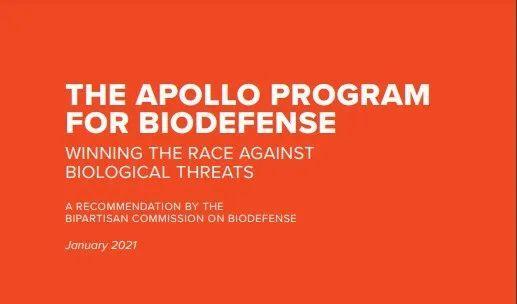
On January 15th, the bipartisan committee on biological defense in the United States released the report "Apollo Biological Defense Plan: Overcoming Biological Threats", suggesting that the US government urgently implement the "Apollo Biological Defense Plan", formulate the National Biological Defense Science and Technology Strategy, focus on developing 15 key technologies, and invest 10 billion US dollars every year, so as to end the era of COVID-19 pandemic threat by 2030 and eliminate the vulnerability of the United States to biological attacks.

Related background
Formerly known as the "Blue Ribbon Study Group on Biological Defense", the Bipartisan Committee on Biological Defense in the United States is a high-end biological defense think tank in the United States composed of former senior decision makers and experts from both parties.The main function is to evaluate the current situation of biological defense in the United States and put forward suggestions for reform. The National Biological Defense Strategy of the United States, which was promulgated in September 2018, originated from its suggestions. Since 2019, the Committee has evaluated the comprehensiveness and effectiveness of the US biological defense research and development work by reviewing the US government’s strategies, plans and R&D projects in the field of biological defense, and determined the basic objectives of the Apollo Biological Defense Plan.On January 15, 2021, the report "Apollo Biological Defense Program: Overcoming Biological Threats" was officially released..
The Committee believes that the Covid-19 pandemic has sounded the alarm for the United States, and the world can no longer regard a devastating biological event like the Covid-19 pandemic as a once-in-a-century rare event, and the next biological threat may be even more destructive. The continuous breakthrough of biotechnology has reduced the barriers to obtaining or modifying pathogens, lowered the technical barriers to manufacturing biological weapons, raised concerns about new biological agents with unknown serious diseases, and increased the possibility of a pandemic caused by deliberate biological attacks or laboratory accidents. Biological threats have endangered national security, affected military tasks, and shaken the deterrent ability. Opponents have clearly seen the weakness of the United States in responding to biological attacks, and may take this opportunity to challenge the dominant position of the United States and test its ability and willingness to maintain global order. Therefore, the United States should immediately implement the "Apollo biological defense plan", develop the ability to resist all biological threats, and end the threat of pandemic within ten years.
Main points of report
The report puts forward the basic ideas and implementation suggestions of the Apollo biological defense plan, and determines 15 key technologies that should be included in the priority development of the plan.
(A) the basic idea of the plan
The "Apollo Biodefense Plan" will draw on the successful experience of the "Apollo Moon Landing Plan" and other large-scale projects, and be organized by the government in a unified way, coordinating and mobilizing relevant forces such as federal government departments, academia and private enterprises. On the basis of investigating the measures taken by the United States to deal with COVID-19, Ebola and other epidemics, it will formulate a national road map for biological defense, develop the ability to eliminate biological threats, and effectively respond to the enormous challenges of biological threats. The Bipartisan Committee on Biological Defense believes that the implementation of this plan will give the United States the opportunity to mobilize national strength and lead the world to meet the challenge of biological threats, and it is expected to realize the traceability and continuous tracking of any new pathogens in the next decade, and to distribute rapid and instant single-person detection tools to every family in the country, and to complete the development and distribution of vaccines within a few weeks, thus forming an effective treatment plan, thus completely eliminating the threat of pandemic. In addition, the plan may also make breakthroughs in the fields of precision medicine, sustainable food production, large-scale manufacturing, space travel, etc., and promote the bio-economic growth of the United States and enhance the national strength.
(II) Implementation recommendations
In order to implement the Apollo biological defense plan, the report puts forward four suggestions:
The government and Congress should fully implement the relevant recommendations of the 2015 National Biological Defense Blueprint report, so that the United States can effectively deal with intentional introduction, accidental release and natural biological events.Specific suggestions include: emphasizing innovation first; Take incentive measures for enterprises that develop medical products; Encourage the development of rapid and immediate diagnostic tools and methods; Develop modern environmental biological threat monitoring system.
The government should formulate and implement the National Biological Defense Science and Technology Strategy.The National Bio-defense Science and Technology Strategy should be an annex to the National Bio-defense Strategy, focusing on the technical priorities of the Apollo Bio-defense Plan. The plan should be led by the full-time deputy assistant to the chairman of the National Security Council, and the director of the National Science and Technology Policy Office is responsible for determining the priority of the required technical capabilities and the R&D arrangements.
Congress should implement unified budgeting for biological defense.Congress should ask the Office of Management and Budget to provide the cross-departmental budget of the Apollo Biological Defense Program as a part of the unified budget for biological defense, so as to coordinate strategic inter-agency work.
Congress should provide multi-year funding for the Apollo biological defense program.The amount of planned funds should meet its target requirements, and Congress should give it multi-year budget authorization to support government agencies to purchase medical products that take several years to develop and produce.
(III) 15 key technical priorities
According to the opinions of 125 experts, the bipartisan commission on biological defense has determined 15 key technical priorities of the Apollo biological defense plan.
-Prototype pathogen candidate vaccine.For 25 virus families that are known to infect humans, invest in the development of vaccines for at least one prototype pathogen for each virus family to prepare for the next unknown biological threat.
-Therapeutic drugs for multiple pathogens used before the outbreak.Develop effective therapies against multiple strains of viruses, including host-directed antiviral drugs and monoclonal antibodies.
-Flexible and scalable drug manufacturing.Develop platform technology (that is, the technology of producing drugs or vaccines for many different pathogens using the same process) to ensure the large-scale rapid production of drugs and vaccines for the next pandemic pathogen.
Needle-free administration of drugs and vaccines.Develop self-administration technology to deliver drugs and vaccines into the body through skin, nose, inhalation and oral administration.
-ubiquitous sequencing.Develop metagenome sequencing technology and new sequencing methods, and give priority to technologies that can achieve miniaturization, few reagents or even no reagents.
-Minimally invasive and non-invasive infection detection.Develop wearable devices and non-invasive and minimally invasive detection technologies to detect volatile compounds emitted by individuals, and realize the detection of high-risk, high-concern and sentinel population infections.
-Large-scale multiplex detection capability.Develop technologies that can detect multiple pathogens, drug-resistant genes and biomarkers at the same time, and give priority to technologies that can move detection out of centralized laboratories.
-Quick and instant personal diagnosis.Develop easy-to-obtain, minimally invasive, portable and easy-to-operate individual infection detection technology, and realize the integration of personal detection and diagnosis data with public health data system.
-Digital pathogen monitoring.Establish a system to monitor biological threats inside and outside the United States, and realize data interoperability with the National Center for Pathogen Monitoring and Prediction.
-Establishing a national public health data system.Effectively integrate management and timely analyze data from public health institutions at all levels of government.
-Establish a national pathogen monitoring and forecasting center.Collect data from clinical molecular diagnosis, sentinel surveillance and other sources in real time, improve the prediction of infectious diseases through modeling, and effectively deal with seasonal infectious diseases and emerging and engineering pathogen threats.
-A new generation of personal protective equipment.Develop personalized single-person protective equipment that can be reused and suitable for all people, and establish and maintain distributed production capacity.
-Suppress the spread of pathogens in the built environment.Develop affordable air filtration and sterilization systems, sterilization materials, neutralization of pollutants, real-time perception of pathogens and other technologies and capabilities to reduce the spread of pathogens through air, droplets and media.
-Biosafety of comprehensive laboratories.Study and analyze laboratory accidents, develop new functions and tools to ensure laboratory biosafety, realize laboratory biosafety system, and finally deploy it to all biosafety laboratories.
—Techniques to stop and prevent malicious actors.Develop biological attribution, genetic engineering detection and other technologies, use machine learning technology to distinguish natural and engineered DNA, and improve the ability of investigation, evidence analysis and attribution for intentional biological events.
Disclaimer:This article is transferred from the national defense science and technology news, the original author Hao Jiying. The content of the article is the author’s personal opinion, and this WeChat official account reprint is only for sharing and conveying different opinions. If you have any objections, please contact us!
Transfer from national defense science and technology news
Author Hao Jiying
Editor Zhai Liying

Brief introduction of the institute
International Institute of Technology and Economics (IITE) was established in November 1985. It is a non-profit research institution affiliated to the State Council Development Research Center. Its main function is to study major policy, strategic and forward-looking issues in China’s economic, technological and social development, track and analyze the world’s technological and economic development trends, and provide decision-making consulting services for the central government and relevant ministries. "Global Technology Map" is the official WeChat account of the International Institute of Technology and Economics, which is dedicated to delivering cutting-edge technical information and scientific and technological innovation insights to the public.
Address: Building A, Building 20, Xiaonanzhuang, Haidian District, Beijing
Tel: 010-82635522
Reporting/feedback