[International] New Trends of EU Foreign Investment Policy System and Its Impact on China-EU Mutual Investment | China Investment
Original Yuanshenglong China Investment Reference
Yuanshenglong
Deputy Director, Trade and Investment Research Office, Institute of Foreign Economic Research, National Development and Reform Commission
guide reading
In recent years, the EU’s direct investment policy system has been constantly adjusted, showing the characteristics of expansion of exclusive rights, strengthening of investment barriers and rising demand for differentiated investment. The scale of two-way investment flows in Europe has also entered a period of fluctuation adjustment.
● The overall situation of EU’s direct investment policy system
● The new trend of EU’s participation in international regulation of direct investment.
● The change trend of deposit and flow of EU two-way investment.
● The influence of EU direct investment policy system adjustment on China-EU mutual investment and its countermeasures.
In recent years, the EU’s direct investment policy system has been constantly adjusted, showing the characteristics of expansion of exclusive rights, strengthening of investment barriers, and rising demand for differentiated investment. The scale of two-way investment flows between China and Europe has also entered a period of fluctuation adjustment. China’s investment cooperation with Europe has maintained steady growth on the whole, but the unfavorable constraints brought about by the adjustment of European policies have increased. In the future, we should further promote policy communication with Europe, strengthen policy tracking with Europe, and explore new mechanisms and new space for two-way investment cooperation with Europe.
The overall situation of EU’s direct investment policy system
The concept and jurisdiction of direct investment in the European Union have expanded in policy. Generalizing the concept of direct investment and strengthening the legislative exclusive power in the investment field are important new trends in the promotion of the EU’s direct investment policy system in recent years. In the relevant policies of EU common legislation, at present, the standard of dividing foreign direct investment and indirect investment is still 10%, but foreign investment is no longer clearly divided. The European Commission and other EU investment authorities believe that cross-border investment made by enterprises or individuals for the purpose of obtaining raw materials, cost-benefit and technology seeking can be regarded as foreign direct investment as long as the investment involves part or all of foreign capital’s control over enterprises in the EU. As for jurisdiction, the Lisbon Treaty designates part of the jurisdiction over security affairs and direct investment as the legislative authority of member States, and there has always been a dispute over the exclusive rights of the unified legislation on direct investment in the European policy. However, with the implementation of the Framework Regulation on the Review of Foreign Direct Investment in the European Union and the completion of the negotiation of the China-EU Comprehensive Investment Agreement, it shows that the European side has made obvious breakthroughs in the direction of unified foreign investment supervision policies and consistent caliber.
The EU’s policy of attracting foreign investment and supervising foreign investment has been promoted simultaneously. In terms of attracting foreign investment, according to the official explanation of the European Commission, since 2009, the EU has formulated policies on attracting foreign investment on behalf of its member States. The main policy objectives include: promoting fair competition, facilitating investment and supporting sustainable development. The specific contents are scattered in the policies and regulations of the EU in the fields of trade, competition, science and technology. In addition, except for sensitive areas identified by the EU and its member states, foreign investors can enjoy the same national treatment as European enterprises when investing in the EU, and foreign-invested enterprises can also enjoy the same support policies such as tax and non-tax burden reduction, transfer payment and credit support formulated by governments at all levels in the EU and its member states. In practice, the European Commission and other EU institutions play a more coordinating, promoting and promoting role in corporate policies, and most of the means used are to provide financial support to specific industries by setting up funds, publishing research reports, and promoting information exchange among member States. However, while actively attracting foreign investment, the EU has increasingly emphasized the protection of its own interests and industries in recent years. In addition to strengthening the safety review of foreign investment, during the epidemic period, it also introduced special policies to restrict foreign investment, such as state subsidies and mergers and acquisitions in the pharmaceutical industry.
EU government fund projects are the main policy tools to support recovery and enterprises to expand international cooperation. Including but not limited to: the EU Recovery Fund (RRF), which is the core tool of the "Next Generation EU" European recovery plan, and the member countries can get EU financial support after successfully completing the pre-set goals. The European Union Structure and Investment Fund (ESIF) is a fund set up by the EU from the budget to implement regional policies and narrow the development differences between different regions of the EU. It is mainly used to build infrastructure for economically backward areas, promote enterprise investment, support economic and social adjustment, update the education and training system and promote employment. European investment fund, whose task is to provide financial assistance to small and medium-sized enterprises. Cohesion policy fund: In response to the energy crisis, in 2022, the European Commission also introduced a special policy to allow countries to allocate nearly 40 billion euros of "cohesion fund" from the EU budget to help vulnerable families and small businesses affected by high energy prices.
New Trends of EU’s Participation in International Regulation of Direct Investment
First, emphasize the related content of direct investment in service industry in the FTA negotiations. 60% of the EU’s direct investment in foreign economies is in the service industry, while nearly 90% of foreign direct investment entering the EU is in the service industry. Up to now, the EU has signed 44 free trade agreements with 76 trading partners. In recent years, in the negotiation of service and digital trade terms of trade agreements, the EU has further emphasized the need to ensure that EU service providers are allowed to provide services in the market of the other country and enjoy the same national treatment as local enterprises. At the same time, the EU has further clarified the protection of foreign investment, such as facilitating the entry of foreign direct investment enterprises, promising to enjoy national treatment and non-discrimination within the EU, establishing a fair regulatory framework, and ensuring compensation when foreign-funded enterprises are requisitioned under special circumstances. The EU-Canada Comprehensive Economic and Trade Agreement (CETA) includes the most comprehensive investment-related service trade clauses negotiated by the EU so far, and forms a negative list of direct investment in service industry for the first time.
The second is to reform the intra-Union investment dispute settlement mechanism and promote WTO reform. After reaching an agreement on the reformed investment dispute settlement scheme in November 2015, the European Union began to promote the establishment of a permanent dispute settlement mechanism called "investment court system", which aims to ensure that every relevant subject follows the same investment protection rules, and strives to "strike a balance between protecting investors in a transparent way and the right of the state to supervise and safeguard public policy objectives". At present, while further improving the construction of the investment dispute settlement mechanism, the European Commission is actively seeking to establish a multilateral investment court with all its trading partners to adjudicate investment disputes. In the process of WTO reform, the EU is also promoting issues related to investment facilitation, including mutual disclosure of information about investment rules by member States and reducing the time for obtaining relevant government permits. Establish a more transparent, effective and predictable business environment for investors through investment facilitation, and benefit developing countries.
The third is to further standardize the investment agreements between EU member states and non-EU countries. By 2022, the EU and its member states had reached more than 1,400 bilateral investment agreements and entered into force. In 2012, the EU introduced specific regulations to regulate the signing of investment agreements by member states, and the European Commission completed an evaluation report on the implementation of the regulations in April 2020. Based on the evaluation results, the EU will promote the revision and update of the regulations, and further standardize the contents of investment agreements signed by member States in the following areas: first, transparency and predictability of investment measures, streamlining and speeding up administrative procedures and requirements, and second, consistency of supervision over foreign-funded enterprises; Second, special and differential treatment for developing countries and least developed countries; III. The contents of the bilateral agreements do not violate EU laws and conform to the principles and objectives of the EU’s external actions.
Fourth, actively participate in international policy coordination. The EU participates in international organizations related to two-way direct investment, including the Investment Committee of the Organization for Economic Cooperation and Development (OECD), the World Investment Forum of the United Nations Conference on Trade and Development (UNCTAD), the Committee on Trade-related Investment Measures (TRIMs) of the World Trade Organization (WTO) and the structured discussion on investment facilitation, the Third Working Group on Investor-State Dispute Settlement Reform of the United Nations Commission on International Trade Law, the International Centre for Settlement of Investment Disputes (ICSID) and the Energy Charter.
Trend of deposit and flow of two-way investment in EU.
Both the deposit and flow of two-way investment in the EU have entered an adjustment period. The stock scale of EU’s foreign investment and foreign investment absorption accounts for about one-third of the global total, with an average annual growth rate of about 3.5%, and it has long maintained one of the most important two-way investment locations in the world. From the perspective of traffic, the stage peaks of two-way investment in the EU all appeared in 2015, and since then, it has generally fluctuated downwards, which is basically consistent with the investment development trend of major developed economies. Especially in 2020, due to the global epidemic, the EU’s two-way investment, especially the absorption of foreign capital, shrank sharply. In that year, the total flow was recorded for the first time to drop to "-4 billion US dollars". In 2021 and 2022, the two-way investment in the EU recovered, but it still did not return to the pre-epidemic level.
By the end of 2022, China’s stock of EU investment accounted for about 4% of the EU’s total foreign investment, and my stock of direct investment in Europe accounted for about 3.6% of its total foreign investment. There is still a certain gap compared with the major EU investment partners such as the United States, Britain and Switzerland, but the two-way investment between China and the EU has grown rapidly, making it the most active investment partner. According to data from the Ministry of Commerce, in 2022, the EU’s direct investment in China was 12.1 billion US dollars, a substantial increase of 70%; China’s direct investment in the EU was US$ 11.1 billion, up by 21%.
The Second Annual Report on the Review of Foreign Direct Investment in the EU issued by the European Commission in September 2022 shows that. In 2021, the EU absorbed 117 billion euros of foreign direct investment, which decreased by 31% and 68% respectively compared with 2020 and 2019. In 2021, the number of EU M&A and greenfield investment transactions increased by 32% and 12% respectively compared with 2020, but still decreased by 9% and 39% respectively compared with 2019.
From the perspective of investment source countries, the United States is the largest source of foreign investment in the EU in 2021, accounting for 32.3% and 39.4% of the number of mergers and acquisitions and greenfield investment transactions; Followed by Britain, accounting for 25.6% and 20.9% respectively. The proportion of China’s investment transactions in Europe in M&A investment and greenfield investment decreased from 3.4% and 7.1% in 2020 to 2.3% and 6% in 2021, but China’s investment in Europe increased from 6.5 billion euros in 2020 to 9 billion euros in 2021.
From the perspective of investment destination countries, Germany accounts for 16.4% in the number of M&A transactions, making it the first destination country for foreign investors to conduct M&A transactions in the EU in 2021, followed by Spain (13.8%), France (10.7%) and the Netherlands (10.5%). In the number of greenfield investment transactions, Spain accounted for 22.2%, making it the largest destination country for foreign greenfield investment in the EU in 2021, followed by France (12.7%) and Germany (11.2%).
From the perspective of investment industry, foreign investors’ investment industry in the EU mainly focuses on information and communication technology (ICT) and manufacturing. Among them, ICT accounted for 30% (the first place) and 15.4% (the second place) in the number of mergers and acquisitions and greenfield investment transactions, respectively; The manufacturing industry accounts for 25.9% (second place) and 12% (third place) in the number of mergers and acquisitions and greenfield investment transactions, respectively; The retail industry accounts for the highest proportion in the number of green space investment transactions, accounting for 28%.
In terms of foreign investment review, in 2021, two-thirds of EU member states have established investment review mechanisms, seven countries including Belgium are in the process of legislation, and only Bulgaria and Cyprus have not started the establishment of investment review mechanisms. Of the 1,563 cases reported by EU member states in 2021, about 29% were formally reviewed, up from 20% in 2020.
The influence of EU’s direct investment policy system adjustment on China-EU mutual investment and its countermeasures
In recent years, the adjustment and standardized development of the EU’s direct investment policy system are contradictory. On the one hand, the EU has continuously increased the examination of foreign investment and raised investment barriers in an all-round way, which has led to the overall cooling of the EU’s long-term capital market. However, the EU attaches great importance to the role of foreign capital in boosting the EU’s post-epidemic economic recovery, and has expanded its attraction and utilization of foreign capital through various policies. On the other hand, the EU actively promotes the signing of investment agreements with foreign businessmen or introduces more substantial investment clauses in free trade negotiations. However, the EU has shelved the entry into force of China-EU Comprehensive Investment Agreement (CAI) at the expense of "the interests of enterprises within the EU". In addition, the EU actively exerts its own experience advantages in the field of regulation and constantly improves various investment-related laws and regulations. However, the European Union has blurred the regulatory rules in investment review and other fields, which leads to the increase of the cost and uncertainty of foreign capital entry.
Generally speaking, the EU is still in the process of constructing and perfecting the two-way direct investment policy system, and the EU investment policy environment has entered an adjustment period. During this period, I should strengthen the follow-up study on the EU’s relevant policy trends, while continuously optimizing the domestic business environment, enhance my ability to grasp the changes in the EU’s investment environment, and effectively stabilize the basic disk of mutual investment and cooperation between China and Europe.
The first is to strengthen policy communication. Strengthen policy docking and do a good job in top-level design through communication and consultation mechanisms such as China-EU leaders’ meeting and China-EU high-level strategic dialogue. Strengthen the policy exchange between China and Europe’s investment authorities, and carry out flexible dialogues among industries, scientific research and people. We will build a more stable and friendly bilateral investment environment and fully hedge against the adverse effects brought about by the adjustment of European policies. At the same time, we should make corresponding preparations and take appropriate countermeasures against the unreasonable control that the European side may take.
Second, do a good job of EU policy tracking in time. The EU is in a critical period of building and updating the investment policy system, and the relevant information changes rapidly. In addition, there are many EU member countries and complicated laws, which bring many obstacles to the effective transmission of information in China, and it is difficult for the relevant policy risks to be captured by the market in time. We should establish a multi-agency cooperation mechanism for tracking and judging the EU’s foreign investment policy as soon as possible, and jointly report and summarize effective information with overseas institutions, domestic authorities, professional law firms and enterprises going abroad, closely follow the latest progress of the EU’s foreign investment policy reform, and provide guarantee for effectively coping with risks. Actively use the dialogue and consultation mechanism between China and Europe in the fields of legal affairs, intellectual property rights, industry, etc., actively carry out dialogue and communication and policy docking with the European side, actively carry out doubts and negotiate the necessity.
The third is to flexibly promote new modes of cooperation with Europe such as third-party cooperation. Promote the innovation of cooperation mode and break the multiple obstacles faced by unilateral project promotion. Actively promote the development and innovation of the third-party cooperation mode, strengthen cooperation with enterprises from other countries, especially developed countries such as the United States and Japan, when investing in EU countries, especially pay attention to combining China’s mid-range manufacturing capabilities with advanced technologies and concepts of developed countries, provide high-level, cost-effective and more competitive products and services to third countries, realize "win-win for all three parties", and enhance the sense of participation and benefit sharing of developed countries such as Europe and the United States in joint investment.
Edit | Qinghe
Proofreading | Yan Jianjun
Design | rice

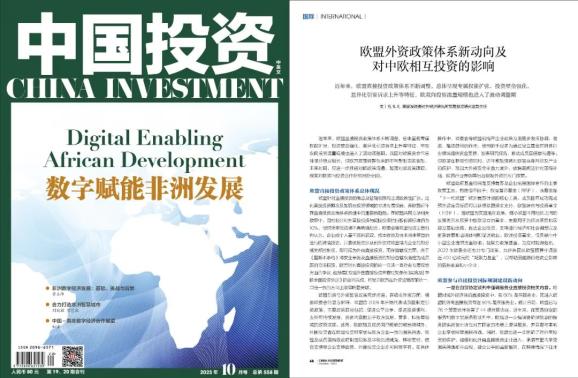
This article was published in the October 2023 issue of China Investment.
All rights reserved, infringement will be investigated.
Personal sharing is welcome. Please reply to this micro-signal for permission for media reprinting.
Founded in 1985, China Investment magazine is headed by the National Development and Reform Commission, sponsored by the Investment Research Institute of the National Development and Reform Commission and China International Engineering Consulting Co., Ltd. It is the only central-level publication in China’s investment field, and the industry is the first core journal to focus on the trend report in the investment field. Since its founding more than 30 years ago, the magazine has looked at China’s investment from a global perspective, covering macro-economy, industry analysis and enterprise investment cases, and focused on specific countries, regions and major international trends with the global market as the coordinate. At present, it has become a professional dialogue platform for government officials, various investment institutions, experts and scholars, entrepreneurs and journalists.
Each issue of China Investment magazine covers more than 200 state-owned enterprises, including listed companies, more than 10,000 private enterprises in China, more than 1,000 decision-making departments and institutions of the central and local governments, more than 1,000 industry associations and chambers of commerce, and more than 300 major financial institutions, which is an important reference for understanding the macroeconomic environment, industry trends and prospects, and enterprise investment cases.
China Investment, founded in 1985, is a monthly under the supervision of National Development and Reform Commission (NDRC) China’s macro-economic management agency, It’s jointly operated by Investment Research Institute under NDRC, China International Engineering Consulting Corporation. Enjoying an exclusive position under the central government, China Investment is the core journal which started the earliest among similar magazines to focus on the investment trend. Over the past 30-plus years, China Investment has been in line with theglobal market as its fundamental coordinate with a strategic focus on specific countries and regional markets and those major international propensities. China Investment is a key dialogue platform for officials from different countries, investment agencies, experts and scholars, business people and journalists.
Original title: New Trends of [International] EU Foreign Investment Policy System and Its Impact on China-EU Mutual Investment | China Investment.
Read the original text